Tel: +86-150-1280-2327 Email: granitecomponents@163.com
- All
- Product Name
- Product Keyword
- Product Model
- Product Summary
- Product Description
- Multi Field Search
 EnglishEnglish
Views: 0 Author: Site Editor Publish Time: 2025-11-18 Origin: Site


In many high-precision inspection lines, engineers often face the same frustrating reality: the camera is ready, the lighting is stable, but the stage still needs extra milliseconds to settle before autofocus can lock. These small delays accumulate into major throughput losses. As manufacturers push for faster cycle times in semiconductor inspection, camera module alignment, and backlight defect detection, more teams are asking whether a Granite Gantry can reshape the balance between speed and accuracy. At SYIN automation technology Co.,Ltd, we have seen how granite-based motion structures help production engineers overcome vibration, flatness, and thermal stability challenges that slow down optical inspection. This article explores why granite gantry systems reduce focusing delays, shorten stabilization time, and bring consistent inspection performance to modern factories.
Optical inspection sits at the center of quality control in semiconductor packaging, camera module manufacturing, display production, and precision machining. Its value depends on two outcomes: how fast it can complete a full scan, and how reliably it can maintain micron-level accuracy across thousands of cycles.
As more production lines adopt high-speed cameras, sub-micron encoders, and automated defect classification algorithms, mechanical motion has become the bottleneck. Even a few milliseconds of unnecessary settling time affects whole-line takt time.
Despite throughput pressures, inspection still requires repeatable and stable movement. A platform that vibrates, bends under load, or introduces thermal drift directly affects focus, edge contrast, pixel uniformity, and defect detection accuracy.
Balancing these two goals—speed and precision—is why motion structure design matters so deeply in inspection engineering.
High-resolution optical inspection relies on a stable mechanical base. When that base introduces vibration or uneven travel, the inspection system compensates by increasing focus attempts, lowering travel speed, or delaying image capture.
Autofocus systems must wait for motion to settle. If the platform produces micro-vibrations or twist across the stroke, autofocus must repeat one or more cycles. These repeated cycles are a quiet but costly reason for slowed inspection throughput.
Motion stages on metal casting structures often suffer from internal stress, micro-bending, and thermal expansion. This leads to deviations in perpendicularity, flatness, and parallelism, forcing engineers to use conservative travel speeds or higher damping times.
Metal structures resonate more easily than mineral granite, especially in systems using linear motors. Resonance introduces micro-oscillation into captured images, lowering contrast and reducing the reliability of automated defect detection.
These bottlenecks create the perfect environment for granite structures to provide noticeable improvements.
A granite gantry built with a rigid base, stable columns, and a well-designed beam significantly reduces vibration and structural deformation. This directly improves camera autofocus behavior and reduces the mechanical settling time required before image capture.
Granite offers exceptional flatness across long travel strokes. Unlike metal castings, granite contains no internal stress that slowly releases over time. This preserves mechanical accuracy and ensures that each inspection point is reached consistently. With minimal out-of-plane deviation, autofocus algorithms stop wasting time on correction cycles.
Granite has naturally high vibration damping performance. When paired with linear motor modules, it absorbs dynamic forces instead of amplifying them. This results in:
Shorter stage settling time
Cleaner autofocus lock
Higher first-time-right focus accuracy
Better high-resolution image contrast
Lower vibration also reduces blur during motion-blur-tolerant scanning modes, which many factories now use to shorten cycle times.
Granite changes size far less with temperature fluctuations compared to aluminum or steel castings. This reduces thermal drift in long inspections and helps maintain consistent reference positions throughout long shifts.
All these advantages together allow inspection engineers to run faster travel profiles while preserving or even improving image quality.
Granite gantries are now appearing across several industrial applications where a stable inspection platform directly affects product performance.
In fiber-optic communication equipment, coupling alignment requires ultra-fine motion. If the gantry vibrates or distorts, alignment repeatability suffers. Granite significantly improves first-pass alignment and reduces the number of fine adjustments required.
Smartphone camera modules depend on tight tolerances between lenses, sensors, and mechanical frames. Inspection gantries must support high-resolution imaging while moving quickly between modules. Granite structures help maintain flatness across large spans, giving consistent focus during every alignment step.
Backlight inspection requires uniformity analysis across large areas. Gantry beams often span two or three meters. Granite’s stiffness and low deformation under its own weight help preserve accuracy across these spans, allowing faster scanning without introducing sag-related optical distortion.
Across all these examples, operators consistently report improvements such as faster focusing, fewer missed defects, and more predictable cycle times.
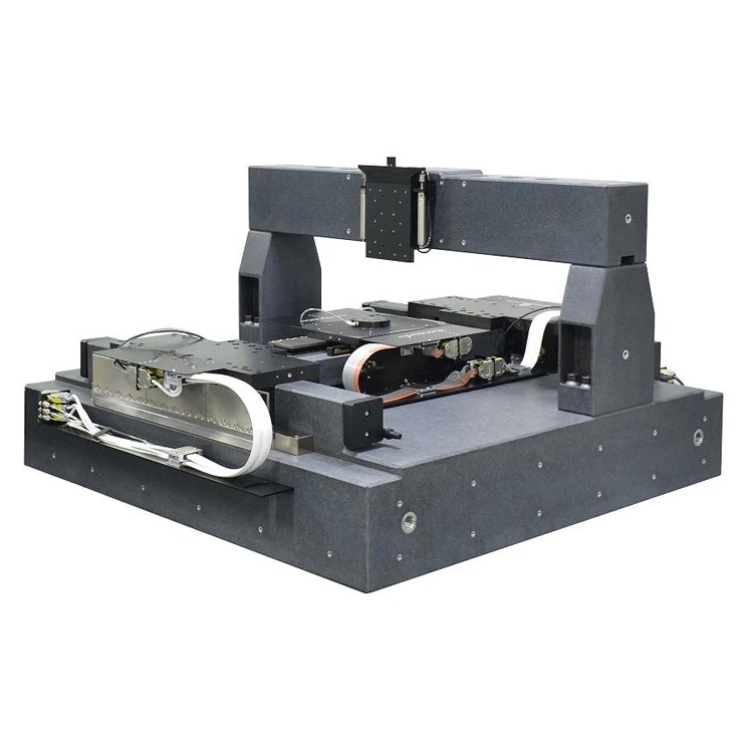
When switching from a metal casting gantry to a granite gantry system, inspection teams typically see multiple measurable benefits.
Reduced vibration means autofocus locks faster and more reliably. Some production lines report a clear drop in repeated autofocus attempts after migrating to granite structures.
Flatness helps maintain constant working distance, reducing brightness, contrast, and distortion variation across different inspection points.
Granite’s natural stability reduces the need for constant recalibration, even in facilities with temperature variation or long operating hours.
In systems where yield depends on consistent optical inspection, granite gantries provide greater repeatability across shift cycles, reducing error contribution from mechanical sources.
These improvements collectively make granite-based inspection platforms a strong fit for high-volume production environments.
A granite structure alone is not enough. The performance of an optical inspection gantry also depends heavily on motion design choices.
Linear motors pair exceptionally well with granite because granite absorbs the dynamic forces they generate. They provide smooth, fast, and vibration-controlled acceleration profiles. Ball screws remain a good choice for lower-speed axes or applications requiring strong thrust at modest speed.
High-resolution encoders are essential for micron-level inspection. Granite supports stable encoder mounting surfaces, enabling the full benefit of interferometric or high-precision optical encoders.
Keeping the moving mass low reduces vibration and improves settle time. Balanced carriage design also ensures smoother transitions during high-speed scanning.
By pairing a rigid granite structure with optimized motion components, manufacturers unlock the full speed potential of their inspection system.
Even the best granite gantry requires proper assembly to meet inspection-grade performance.
Granite surfaces must be clean, free from fine dust, and handled with lint-free materials during assembly. Any contamination affects the fit of linear guides, encoders, and motion modules.
During pre-assembly, reference positions should be checked using calibrated instruments. Parallelism, perpendicularity, and straightness must be measured and verified before final tightening.
Linear modules paired with granite bases need appropriate lubrication to maintain smooth motion at high speeds. Regular care ensures the entire system preserves its precision over time.
A well-assembled granite gantry becomes a long-life platform for demanding inspection tasks.
For production engineers and QA leaders seeking faster inspection cycles without sacrificing accuracy, granite-based structures deliver a proven mechanical advantage. A high-performance optical inspection gantry built on granite enables stable focusing, consistent image quality, and reliable high-speed travel. SYIN automation technology Co.,Ltd continues to support semiconductor, camera module, display, and precision manufacturing customers with granite bases, columns, and long-span beams engineered for demanding inspection environments. To learn more about how our granite structures can improve your throughput and reliability, contact us today.
For project consultations, custom structure design, or technical information about granite gantry components, please contact our engineering team. We are ready to support your inspection system upgrade.
Granite reduces vibration and structural deformation, allowing the autofocus system to lock more quickly and the stage to settle faster, directly increasing inspection throughput.
Granite has no internal stress, excellent flatness, and superior vibration damping. These characteristics help maintain accuracy during long travel strokes and high-speed motion.
Yes. Granite pairs very well with linear motors thanks to its rigidity and damping, which absorb dynamic forces and reduce resonance that would affect image stability.
Semiconductor manufacturing, optical fiber communication equipment, camera module alignment, display and backlight inspection, and precision machining industries all rely on stable, accurate, and fast optical inspection platforms


